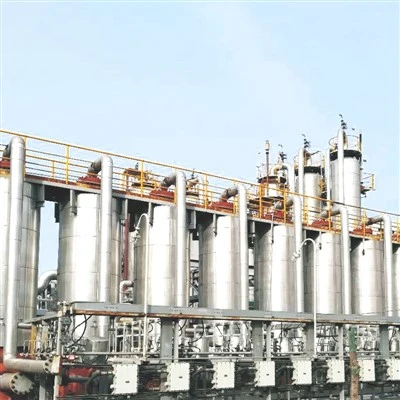
Introduction
The LNG Vaporization Station Equipment is an industrial thermal and pressure-regulation installation that converts liquefied natural gas from its liquid state back into its gaseous form at ambient temperatures.
Product Specification
|
Category |
Key Specification |
|
Ambient Air Vaporizer (AAV) |
Dual-bank design, 8-fin aluminum extrusion |
|
Forced Draft Vaporizer |
External airflow-assisted vaporization system |
|
Water Bath Vaporizer |
Thermally controlled water loop heating system |
|
Materials (Cryogenic Path) |
6063-T5 aluminum / 316L stainless steel |
|
Anti-frost Operation |
4–8 hour automatic bank switching cycle |
|
Fin Spacing Design |
80–120 mm variable inlet spacing |
|
Thermal Shock Resistance |
Up to 180°C rapid temperature gradient tolerance |
Product Parameters
|
Category |
Key Specification |
|
Flow Capacity Range |
1,000 – 40,000 Nm³/h per skid |
|
Pressure Rating Options |
40 / 100 / up to 350 bar systems |
|
MAWP Test Standard |
1.5 × MAWP hydrostatic pressure test |
|
Pressure Drop |
< 0.05 MPa at full design flow |
|
Turndown Ratio |
10:1 operational flexibility |
|
Modular Expansion |
Multi-skid scalable architecture |
|
MOQ |
From 1 skid unit |
Key System Features
Integrated Turnkey Skid Design: Pre-fabricated structural steel skids combining vaporizer manifolds, regulation loops, filtration, and metering within a single 12 m × 2.4 m frame (for standard 5,000 Nm³/h stations). This compact design minimizes on-site concrete foundation work.
Dual-Stage Pressure Regulation: A 1+1 redundant active/monitor configuration utilizing Fisher or Tartarini valves. Allows full online maintenance and inspection without downstream flow interruption or plant shutdown.
Fiscal Custody Transfer Metering: Temperature and pressure-compensated turbine or ultrasonic flow meters delivering ±0.5% accuracy. Fully compliant with OIML/MID legal metrology standards for direct commercial invoicing.
Duplex Coalescing Filtration: Parallel duplex system configured with 5-micron fiberglass elements and a 3-way changeover valve, enabling zero-downtime filter element replacement during continuous plant operation.
Safety Systems
SCADA-Ready Automation
Equipped with Siemens S7-1500 or Allen-Bradley CompactLogix PLCs supporting native Modbus TCP/IP or Profinet, ensuring seamless integration into the plant's existing distributed control system (DCS).
Dual-Layer Overpressure
Fast-acting pneumatic Slam-Shut Valves (ESV) isolate the downstream network within ≤2.0 seconds if downstream pressure spikes or gas temperature drops below −10 °C, preventing catastrophic brittle fracture of downstream carbon steel piping.
SIL 2 Certified Safety Instrumentation
Independent Safety Instrumented System (SIS) utilizing 1oo2 voting logic across dual-redundant PT100 temperature transmitters and 4–20 mA pressure sensors to eliminate single-point failures.
Uninterruptible Power Supply (UPS)
Internal 24 VDC battery backup guaranteeing 120 minutes of continuous remote telemetry, PLC operation, and emergency valve actuation during a main grid power failure.
Compliance & Certifications
All pressure vessels and piping are designed, manufactured, and certified in strict accordance with ASME Section VIII Division 1, EN 13445, and PED 2014/68/EU.
100% radiographic testing (RT) on cryogenic welds, 4-hour hydrostatic pressure test at 1.5× design pressure, and helium leak testing. Full material traceability is provided via EN 10204 3.1 certification.
Structural skids are certified to IBC Zone 4 and Eurocode 8 seismic ratings, withstanding sustained wind loads up to 160 km/h.
C4/C5 Marine-Grade Corrosion Protection: Hot-dip galvanized framing (ISO 1461, minimum 85 µm coating thickness) with SS316 fasteners eliminates the need for on-site repainting in highly corrosive coastal or industrial environments.
Variable fin spacing profiles prevent ice bridging across adjacent tubes, maintaining 100% rated thermal efficiency during continuous sub-zero winter operations.

On-Site Commissioning Support
Factory Acceptance Testing (FAT)
100% pre-shipment validation at our facility, including comprehensive I/O loop checks, pneumatic pressure hold tests, and control logic simulation.
On-Site Commissioning (SAT)
Deployment of OEM-certified field engineers to supervise anchoring, pipeline tie-ins, final Site Acceptance Testing, and controlled cryogenic cool-down.
Technical Handover & Training
Structured, hands-on training modules for plant operators covering PLC diagnostics, regulator calibration, and safety loop/ESV manual resets.
FAQ
Q: What is the typical service life of the LNG vaporization station equipment?
A: The standard design life is 15–20 years under continuous industrial operation. Critical cryogenic components such as aluminum fin banks are typically inspected every 5 years and replaced only if thermal efficiency drops below 85%.
Q: What is the expected commissioning time after equipment delivery?
A: A standard 5,000–10,000 Nm³/h skid system requires 10–18 days for full on-site installation and commissioning. This includes mechanical hookup, cold circulation testing, and full SIS safety loop validation.
Q: How often does the system require scheduled maintenance shutdowns?
A: Planned maintenance is generally required once every 6–9 months depending on LNG impurity levels. Each maintenance window typically lasts 8–16 hours without affecting upstream LNG storage operations.
Q: What is the average power consumption of the forced draft vaporizer system?
A: Forced draft systems typically consume 18–45 kW per vaporization skid, depending on airflow demand and ambient temperature. Energy usage peaks during winter operation when ambient air temperature drops below −5°C.
Q: Do you provide real operational project references?
A: Yes, standard deployments include industrial gas distribution stations and peak-shaving LNG regasification terminals. Typical installations operate in environments ranging from −30°C cold regions to coastal high-humidity zones.
Q: What is the guaranteed uptime of the vaporization station?
A: Under normal operating conditions, system availability is designed to exceed 99.2% annually. Redundant valve configuration and dual-bank vaporizer switching allow continuous operation during maintenance cycles.
Q: What is included in the warranty period?
A: The equipment is typically covered by a 24-month warranty from the date of commissioning. Cryogenic heat exchange modules and control systems include extended optional coverage up to 60 months under service agreement.
Q: How fast can spare parts be supplied in case of failure?
A: Critical spare parts such as control valves and sensors are typically available within 48–72 hours via regional warehouse dispatch. Non-critical mechanical components are supplied within 7–14 working days.
Q: What is the typical lifecycle operating cost structure?
A: Annual operating cost is mainly driven by electricity for forced draft systems and periodic valve maintenance. For a 10,000 Nm³/h station, typical OPEX is 2–4% of initial CAPEX per year.
Q: Can the system operate under extreme winter conditions?
A: Yes, the system is designed for continuous operation down to −40°C ambient temperature. Anti-frost cycling and dual-bank switching ensure stable vaporization efficiency even during prolonged sub-zero operation.
Hot Tags: LNG vaporization station equipment, China LNG vaporization station equipment manufacturers, lng vaporization station, LNG Vaporization Station Equipment, LNG Vaporization Supercharger, Natural Gas Pressure Regulation and Metering Skid